


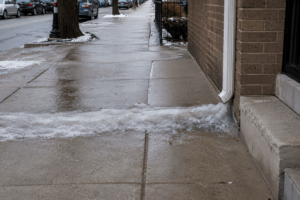
Illinois is one of the harder states in the country in which to win a slip and fall case involving snow or ice. Most people assume the opposite. A property owner let ice build up, someone got hurt, and it feels like the owner should answer for it. Illinois law starts from a different place, and understanding where it starts explains why some winter falls produce strong claims and others produce nothing at all.
The following explains the natural accumulation rule, the statute that protects residential owners, and the specific circumstances that do create liability after a Chicago winter fall.
The Natural Accumulation Rule
Illinois courts have long held that property owners generally owe no duty to remove natural accumulations of snow, ice, or meltwater from their property. Snow falls, it freezes, and the law treats that as a condition of living in a northern climate rather than as negligence by whoever owns the ground it landed on. The rule is settled enough that Illinois maintains pattern jury instructions specific to falls on snow and ice.
The rule reaches further than most people expect. There is generally no duty to warn about a natural accumulation, no duty to clean up snow and water tracked inside by other customers, and no duty to put down mats at an entrance. A fall during or right after a storm, on ground that is uniformly snowy and icy, with no unusual drainage or defect involved, is the hardest version of this case.
The Snow and Ice Removal Act Protects Owners, Not Victims
Illinois also has a statute in this area, and it works in the opposite direction from what its name suggests. The Snow and Ice Removal Act does not require anyone to shovel. It grants immunity to residential property owners who voluntarily clear snow or ice from sidewalks abutting their property, so that the act of shoveling does not expose them to a lawsuit if someone later slips.
The legislature passed it to encourage shoveling. Three limits are built into it, and each one matters. It applies to residential property, not commercial buildings, shopping centers, or office parks. It applies to sidewalks abutting the property, not parking lots, driveways, or interior walkways. And the immunity falls away where the owner’s conduct was willful and wanton rather than merely careless.
Click to contact our personal injury lawyers today
Unnatural Accumulation Is Where Claims Live
The natural accumulation rule has a mirror image. Where the ice was not natural, the analysis changes entirely, and the property owner can be liable for a condition they created or made worse.
Unnatural accumulation typically comes from something the property does to the water rather than from the weather. A broken or misdirected downspout that discharges across a walkway and refreezes. A roof or canopy that drains onto an entrance. Grading that channels meltwater into a low spot that ices over every thaw. Plowing that piles snow uphill from a pedestrian route so runoff crosses it and freezes each night. A defective gutter that produces the same patch of ice in the same place all winter.
These cases are strongest when the ice is isolated rather than everywhere. A photograph showing a mound of ice at the mouth of a downspout, with clear pavement around it, tells a story that a photograph of a uniformly icy lot cannot.
For a Free Legal Consultation

Voluntary Undertaking Changes the Duty
The other route to liability starts when someone takes on the job. A commercial property owner, a landlord, or a condominium association that undertakes snow removal, whether by its own crew, by contract, or by a promise in a lease, assumes a duty to perform that work with reasonable care.
This is where many of the stronger Illinois winter cases sit. A retail center hires a plowing contractor. The contractor clears the driving lanes and pushes the snow into a pile that drains across a pedestrian walkway, where it refreezes overnight. The store, the management company, and the contractor can all be in the chain of responsibility. A landlord whose lease promises snow removal and who then does it poorly is in a different position than a landlord who promised nothing.
Defects Alongside the Ice
Ice is sometimes only part of the hazard. A missing or loose handrail on exterior stairs, treads that violate the building code, inadequate lighting at an entrance, or a walking surface in disrepair can each create liability independent of the snow, with the ice being the circumstance in which the underlying defect caused an injury.
Framing matters here. A claim built purely on ice runs straight into the natural accumulation rule. The same fall, framed as a premises case about a stairway with no handrail, is a different claim with a different analysis. Which framing fits is a question of fact, and it usually depends on evidence that has to be gathered before the winter ends.
What to Do After a Winter Fall
Photograph the scene immediately, before anyone treats or clears it. Photograph the ice itself, the surrounding area for contrast, any downspout or drainage feature above it, the lighting, handrails, and the general condition of the surface. Ice is the one piece of evidence in personal injury law that destroys itself within hours, and a case that could have been proven often cannot be once the sun comes out.
Report the fall to the property owner or manager and ask for a written incident report. Get names of any witnesses. Seek medical attention promptly, since winter falls commonly produce wrist fractures, hip fractures, and head injuries that need documentation from the outset. Keep the shoes you were wearing.
Note also that a fall on public property may involve a government entity, and claims against local public entities in Illinois run on shorter deadlines than ordinary claims. That distinction catches people who assume they have the usual amount of time.
Whether a winter fall produces a viable claim turns on drainage patterns, maintenance records, weather data for the specific hours involved, and prior complaints about the same spot. Those details are gatherable early and often gone later. If you were injured in a fall on snow or ice, our slip and fall team can evaluate whether the accumulation was natural or something the property created. Where the fall happened on the job, our workplace accident attorneys can address both the compensation claim and any claim against the property owner.
Call 312-971-5959 or Complete a Free Case Evaluation Form