

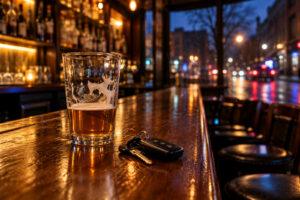
A drunk driver rarely gets drunk alone. Somewhere before the crash, a bar, a restaurant, or a liquor store sold the drinks. The Illinois Dram Shop Act lets the people that driver hurts bring a claim against the seller. Most injured people never learn the claim exists. Those who do often learn too late, because it expires in half the time of an ordinary injury case.
What follows covers who can use the Act, what a claim has to prove, how the dollar limits work in 2026, and why the calendar matters more here than almost anywhere else in Illinois injury law.
What the Statute Actually Says
The rule sits in 235 ILCS 5/6-21, a section of the Liquor Control Act of 1934. Anyone injured in Illinois by an intoxicated person has a right of action against a licensed seller whose alcohol caused the intoxication. The section covers injury to a person and damage to property alike.
The license does not have to come from Illinois. A tavern across the Indiana or Wisconsin line answers in an Illinois court when its customer hurts someone here.
Liability also reaches past the business behind the bar. A property owner or landlord who knowingly permits alcohol sales on the premises shares liability with the seller. So does an adult of 21 or older who pays for a hotel room knowing that people under 21 will drink there unlawfully.
Fault Works Differently Here
An ordinary injury claim asks whether someone acted carelessly. A dram shop claim does not. The Illinois Supreme Court has described the Act as a form of no fault liability. An injured person never has to show that a bartender noticed slurred speech or ignored an obvious problem.
The questions are narrower. Did this licensee sell or give alcohol to this person? Was that alcohol the cause of the intoxication? And did the intoxication cause the injury?
That structure changes which evidence carries the case. Receipts, open tabs, card statements, surveillance video, and the people who shared the table all matter. Much of that material lives on a short retention cycle. A bar may overwrite its camera footage within weeks.
More than one seller can answer for the same crash. A driver who drank at two bars before getting behind the wheel may leave both of them exposed.
Click to contact our personal injury lawyers today
Who Cannot Bring a Claim
The statute closes the door on one person directly. The Act gives the intoxicated person no claim for their own injuries. It gives nothing to anyone claiming support from that person either.
Illinois courts add a second limit and call it complicity. Someone who actively contributed to the driver’s intoxication cannot turn around and collect from the bar. The Illinois Supreme Court tightened that defense in Walter v. Carriage House Hotels in 1995. Drinking in the same room does not trigger it. Actively procuring the drinks does. A passenger who bought the rounds faces the defense, while a passenger who merely shared the evening generally does not.
For a Free Legal Consultation

The 2026 Dollar Limits
Here the Act takes back some of what it gives. Section 6-21 caps what a dram shop pays, and the Comptroller adjusts the caps for inflation every January 20. The 2026 limits allow up to $90,411.55 for each person who suffers injury or property damage. Families claiming loss of means of support or loss of society may recover up to $110,503.00. A family chooses support or society, not both.
Two details catch people off guard. First, the jury never hears about the caps. Jurors set the damages with no instruction on the limits, and the court applies the ceiling afterward. Second, the limit in force on the day of judgment or settlement controls. A crash from 2025 that resolves in 2026 uses the 2026 numbers.
A person with more than one kind of loss can also claim under more than one limit. The statute says so in plain terms. Personal injury, property damage, and loss of support each count separately.
The Caps Do Not Protect the Driver
Those limits apply to the dram shop claim and nothing else. Your claim against the drunk driver remains ordinary negligence, and no statute caps it.
The practical problem lies elsewhere. Illinois requires only $25,000 per person in liability coverage, and a single night in a trauma unit can exceed that. The dram shop claim adds a second insured source of recovery. Your own underinsured motorist coverage can add a third. Serious cases usually need all three.
One Year, Not Two
This part ends more claims than any defense does. The Act bars every action unless the injured person commences it within one year after the cause of action accrued. The negligence claim against the driver carries the usual two years.
So one crash produces two claims on two clocks. A family that waits fourteen months still has a case against the driver and has lost the bar entirely.
One year passes quickly because the first step takes time. Nobody hands a victim the name of the bar. It surfaces through the police report, the criminal case, a card statement, or a witness. Lawyers send preservation letters to every likely seller early for exactly that reason.
What About a House Party
The Act reaches licensed sellers, not private hosts. In Charles v. Seigfried in 1995, the Illinois Supreme Court refused to create social host liability and left the question to the legislature. Lawmakers later wrote a narrow exception for adults who willfully supply alcohol to anyone under 18. Outside that exception, a friend who pours drinks at home does not stand where a tavern stands.
Did a drunk driver hit you after a night at a bar? Our car accident team works to identify every seller before the one year deadline closes, and we pursue the driver and the dram shop together. When a crash takes a life, the loss of society claim runs alongside a wrongful death case. We handle both from our Chicago office and for families who need an Aurora car accident lawyer.
Call 312-971-5959 or Complete a Free Case Evaluation Form