


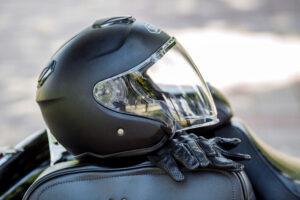
Riders in Illinois hear a version of the same warning constantly. Skip the helmet and an insurance company will use it against you. The warning sounds plausible. Illinois reduces a recovery when the injured person shares blame, so it seems natural that a bare head would cost a rider money. Illinois courts decided otherwise, and they decided it forty years ago. The reasoning has less to do with safety than most people assume.
What follows covers the gear Illinois actually requires, how the state ended up without a helmet law, and the case that shut the helmet defense down.
What the Vehicle Code Actually Requires
Illinois requires no helmet for any rider, at any age. Only three states take that position. Iowa and New Hampshire hold the other two spots.
One piece of gear does carry a mandate. Under 625 ILCS 5/11-1404, the operator of a motorcycle and every passenger must have protection from glasses, goggles, or a transparent shield. The statute spells out what qualifies. Glasses and goggles need shatter resistant material. A transparent shield means either a windshield rising above the eyes of a seated rider or a face shield reaching roughly to the tip of the nose. Contact lenses do not satisfy the section.
So a rider crossing Chicago in sunglasses and no helmet breaks no law. That fact does most of the work in everything below.
How Illinois Ended Up Without a Helmet Law
The state did try. Illinois enacted a helmet requirement in the late 1960s, and the Illinois Supreme Court struck it down in People v. Fries in 1969. The court called the requirement a regulation of what is essentially a matter of personal safety and placed it beyond the police power of the legislature.
A good deal of published material stops at that point and tells riders Illinois cannot require helmets. That understanding is out of date. The Illinois Supreme Court overruled Fries in People v. Kohrig in 1986 while upholding the mandatory seat belt law, observing that the overwhelming weight of authority treats helmet laws as a valid exercise of police power.
Illinois therefore has no helmet law by legislative choice rather than by constitutional bar. The General Assembly simply has never passed another one. That distinction matters to anyone following proposed legislation, though it changes nothing about a claim today.
Click to contact our personal injury lawyers today
The Case That Closed the Helmet Defense
The controlling authority arrived in 1985 and begins with seat belts. In Clarkson v. Wright, the Illinois Supreme Court held that evidence of a driver’s failure to wear a seat belt does not come in on liability or on damages. The court drew a line that reaches well past seat belts. No statute required belt use at the time, and the mere presence of a belt created no duty to wear it, the court said, any more than the presence of a protective helmet in the car would create a duty to wear that.
Months later the Appellate Court applied that reasoning to motorcycles in Hukill v. DiGregorio. A driver turned in front of a rider on Route 83 in DuPage County. The rider owned a helmet and had left it behind that day, and both sides agreed for purposes of the appeal that a helmet would have reduced or avoided his head injuries.
The court still kept the evidence out. Calling Clarkson dispositive, it rejected the helmet defense on mitigation of damages and on comparative negligence alike. An Illinois appellate court reaffirmed that position in Moore v. Swoboda in 1991.
For a Free Legal Consultation

Why the Rule Turns on Duty
Notice what the courts did not say. Neither opinion questions whether helmets work. Hukill assumed the opposite, since the parties stipulated that a helmet would have helped.
The rule rests on duty instead. A person owes no legal obligation to armor themselves in advance against another driver’s negligence. Clarkson also drew a second line worth understanding. Once an injury happens, an injured person does have to mitigate the damage in reasonable ways. That obligation arises after the injury, and the court kept it clearly separate from any duty existing beforehand. A helmet decision made that morning falls on the side of the line where no duty exists.
Where Comparative Fault Still Reaches a Rider
None of this makes a rider immune to a fault argument. Illinois follows modified comparative fault under 735 ILCS 5/2-1116. An injured person recovers nothing once their own share of the blame passes 50 percent, and any award drops in proportion below that.
Real fault arguments target how the crash happened. Speed. Lane position relative to a turning vehicle. Whether a headlight worked. Whether the rider held a valid motorcycle classification. Those arguments succeed or fail on evidence, and they deserve serious attention in a way the helmet question does not.
What an Adjuster Will Try Anyway
Rules of evidence govern a courtroom. They do not govern a phone call. An adjuster evaluating a claim before anyone files suit can raise helmet use freely, and many do, because a rider who believes the argument has merit tends to accept less.
Recognize the move for what it is. The question a court would allow concerns who caused the crash. Where a serious head injury is involved, the medical causation evidence carries far more weight than a conversation about gear ever will.
Did a driver turn across your lane or pull out in front of you? Our motorcycle accident team knows the helmet argument has no place in an Illinois courtroom and says so early, before an adjuster builds a lowball offer around it. Riders hurt by a driver who never looked have the same footing as anyone in a car accident claim, and we pursue both across Chicago and the collar counties.
Call 312-971-5959 or Complete a Free Case Evaluation Form