

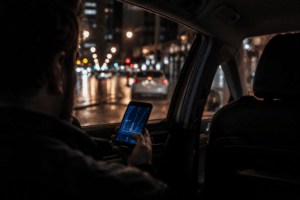
After a rideshare crash, the question that determines almost everything is not who was at fault. It is what the driver’s app was doing at the moment of impact. Illinois law sets different insurance requirements for different phases of a rideshare trip, and the coverage available to an injured person can swing by hundreds of thousands of dollars depending on which phase applies. Two identical collisions on the same Chicago street can produce entirely different outcomes for that reason alone.
The following explains how the phases work, what coverage attaches to each, and what to document after a crash involving an Uber or Lyft vehicle.
The App Status Defines the Coverage
Rideshare coverage is usually described in three phases. In the first, the driver is offline with the app closed, and they are simply a private motorist covered by their own personal auto policy. In the second, the app is on and the driver is waiting for a request but has not accepted one. In the third, the driver has accepted a ride request and is either en route to the passenger or carrying them.
Personal auto policies commonly exclude coverage for commercial use, which means a driver in the second or third phase may have no personal coverage at all. Illinois addressed that gap by requiring the rideshare companies to carry coverage that fills it, with different requirements attaching to each phase.
Once a Ride Is Accepted, Coverage Is Substantial
The Transportation Network Providers Act sets the requirements that apply from the moment a driver accepts a ride request until the ride is complete or the transaction is closed out, whichever is later. During that window, automobile liability insurance must be primary and in the amount of one million dollars for death, personal injury, and property damage.
The statute also requires uninsured and underinsured motorist coverage of fifty thousand dollars from the moment a passenger enters the vehicle. That provision matters more than it sounds, because a substantial share of serious rideshare cases involve a passenger injured by a different driver who carries little or no insurance.
These obligations can be satisfied by a policy the driver maintains, a policy the rideshare company maintains, or a combination, so identifying which insurer actually stands behind the coverage is part of the work rather than a given.
Click to contact our personal injury lawyers today
The Waiting Period Is the Weak Spot
When the app is on but no ride has been accepted, the required coverage drops to contingent liability limits that are far lower than the during-ride figure. This is the phase where injured people most often find that the available insurance does not come close to covering the harm, and it is also the phase most likely to be disputed, since it hinges entirely on app data that the driver and the company control.
The statute requires the rideshare company to disclose to its drivers what coverage it provides and to warn them that their own policy may not cover them while they are using the app. Many drivers have not read that disclosure and do not carry a rideshare endorsement, which is how a driver ends up personally exposed and an injured person ends up with a limited recovery.
For a Free Legal Consultation

Chicago Adds Its Own Requirements
Rideshare operations in Chicago are licensed under the municipal code, which imposes insurance obligations of its own on transportation network providers, including commercial general liability coverage and commercial automobile liability coverage during the period from ride acceptance through completion.
The practical effect is that a Chicago crash may implicate a city licensing requirement in addition to the state statute. That does not automatically produce more money, but it does mean more than one source of obligation to examine, and it gives a reason to look past the first policy an adjuster identifies.
Passengers, Other Drivers, and Pedestrians
A passenger in a rideshare vehicle is almost never at fault for the collision, which usually simplifies liability while leaving open the question of which driver caused it. If the rideshare driver was responsible, the during-ride coverage applies. If another motorist caused it, that motorist’s insurance is primary, with the rideshare policy’s uninsured and underinsured coverage available if the other driver’s limits fall short.
Occupants of other vehicles, pedestrians, and cyclists struck by a rideshare vehicle depend entirely on the driver’s app status at that moment, and they have no way of knowing it from the scene. So do people injured during pickup and drop-off, which in Chicago frequently involves a vehicle stopping in a travel lane, a bike lane, or a bus lane and a passenger opening a door into traffic.
What to Document at the Scene
Screenshot the ride in the app if you were a passenger, including the driver’s name, the vehicle, and the trip details. That record establishes phase three directly and is far harder to dispute later than a recollection.
Photograph the vehicles, the positions, the street, and any rideshare decal in the windshield. Get the driver’s name, license plate, and personal insurance information, and ask directly whether the app was on and whether they had a passenger or an accepted ride. Get witness contact information, since witnesses at a Chicago intersection disperse immediately. Call police and make sure a report is generated, because the report often captures the app status while it is fresh.
Report the crash through the app as well. Doing so creates a record with the company and starts the process of identifying the correct insurer.
After a Rideshare Crash in Chicago
Get medical attention promptly and describe the mechanism of injury accurately. Rideshare passengers are frequently in the back seat without a shoulder belt fully engaged, and the resulting injuries are not always obvious in the first hours.
Expect the coverage question to be contested. The phase determination controls how much insurance is in play, the data that answers it sits with the rideshare company, and preserving it usually requires a formal request rather than a phone call. If you were hurt in a crash involving an Uber or Lyft, our rideshare accident attorneys can pursue that data and identify every policy that applies. We handle car accident claims throughout Chicago and can advise you on how the phases affect your case.
Call 312-971-5959 or Complete a Free Case Evaluation Form