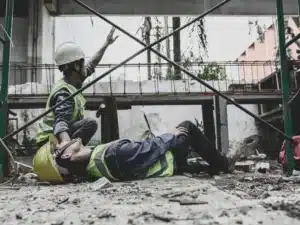



Struck-by incidents injure more construction workers than any other hazard category and rank second only to falls as a cause of construction deaths. The reason they stay near the top of the list is that they do not look dangerous until the moment they are. A wrench set down on a beam, a loader backing up in a gravel lot, a nail gun pointed the wrong way for half a second. Chicago sites compound the problem with tight urban footprints, where material staging, equipment traffic, and pedestrian sidewalks all compete for the same few feet of ground.
The following are the struck-by hazards that put workers in the hospital most often, and the controls that prevent them.
The Four Ways Workers Get Struck
Safety professionals sort struck-by injuries into four categories, and each one calls for a different control. Flying objects are propelled by a tool or a release of energy, like a fragment thrown off a cutting wheel. Falling objects come down from an elevated surface under gravity. Swinging objects move under load, most often a suspended crane load or a piece of material being maneuvered by hand. Rolling objects travel along the ground, which covers vehicles, equipment, and anything on wheels or on a slope.
Sorting a hazard into the right category matters because the fix is different in each case. Eye protection does nothing about a backing dump truck, and a spotter does nothing about an unsecured toolbag two floors up. Crews that treat “struck-by” as a single vague risk tend to control one category well and leave the other three open.
Falling Objects and the Drop Zone
Anything at height that is not secured is a projectile waiting for a reason. Tools, fasteners, offcuts, and material bundles all fall the same way, and even a small object gathers enough energy over a few stories to kill someone standing below.
The controls are simple and routinely skipped. Toeboards and screens keep material from being kicked off an edge. Debris nets and catch platforms intercept what gets past them. Tool tethers keep hand tools attached to the worker rather than to nothing. Most important is the drop zone itself, a marked and barricaded area below overhead work that nobody enters while that work is happening. A drop zone only works when it is enforced, and it stops working the moment a crew decides that crossing it quickly is fine.
Click to contact our personal injury lawyers today
Vehicles, Equipment, and Blind Spots
Mobile equipment kills more workers on foot than most crews expect, and backing operations account for a large share of it. Excavators, loaders, dump trucks, and concrete mixers all have blind areas that the operator cannot see from the seat regardless of how careful they are being. A worker standing in one of those areas is invisible.
Backup alarms help only when the site is quiet enough to hear them, which describes almost no active job site. A trained spotter with an agreed set of hand signals and direct eye contact with the operator is the control that actually works. Workers on foot should never assume an operator has seen them, and should never walk behind equipment that is running. High-visibility apparel is required, but visibility is not the same as protection.
For a Free Legal Consultation

Flying Objects From Powered Tools
Grinders, saws, powder-actuated tools, and nail guns all convert stored energy into motion, and any of them can send material back at the operator or at a bystander. Nail guns in particular cause a steady stream of serious injuries, often from unintended discharge when a contact-trip trigger bumps a surface, and often to a worker who was not the one holding the tool.
Guards belong on tools, not in the gang box. Sequential-trip triggers reduce nail gun injuries substantially compared to contact-trip models. Eye and face protection is required whenever there is a danger of flying particles, and side shields matter as much as the lens because fragments rarely arrive straight on.
Work Zones on Chicago Streets
Roadway and utility work puts crews next to live traffic, which is the one struck-by hazard where the danger is being operated by someone with no safety training and no stake in the site. Work zone setup is governed by traffic control standards that specify how signs, channelizing devices, and flagging stations are arranged, and those layouts exist because drivers behave predictably only when the zone tells them what to do well in advance.
Flaggers face the highest exposure of anyone on the crew. They need high-visibility apparel, a clear escape route planned before the shift, and positioning that never puts them in the path of traffic they are directing. Night work raises the risk again, and lighting that leaves a flagger in shadow defeats the purpose of the vest.
Hard Hats Are the Last Line, Not the First
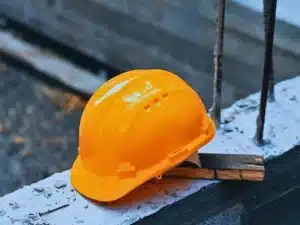
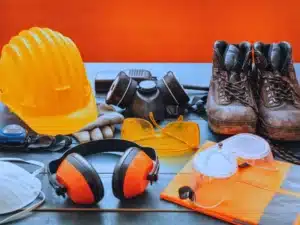
Employers must provide head protection wherever there is a danger of head injury from impact or from falling or flying objects, and that protection has to meet recognized consensus standards. Workers exposed to high-voltage shock need helmets rated for electrical insulation as well.
Personal protective equipment sits at the bottom of the hierarchy of controls for a reason. A hard hat is designed to reduce the severity of an impact that has already happened. It does not prevent the impact, it has real limits on how much energy it can absorb, and it does nothing for the rest of the body. Any site where the primary struck-by strategy is issuing hard hats has skipped every more effective step above it.
After a Struck-By Injury on a Chicago Site
Seek medical care the same day, even if the injury seemed survivable at the time. Head and torso impacts can produce bleeding and swelling that develop over hours, and the treatment record created immediately becomes the foundation of any later claim. Report the incident to the employer in writing and keep your own copy.
Struck-by cases often involve more parties than the employer alone. The load may have been rigged by one subcontractor, the equipment owned and maintained by another, the site coordinated by a general contractor, and the tool that failed built by a manufacturer who could face a separate product liability claim. Workers’ compensation benefits cover medical care and lost wages regardless of fault, but they do not reach those other parties, and a third-party claim can exist alongside them.
Site conditions change fast after an incident. Equipment gets moved, debris gets cleared, and the arrangement that caused the injury stops existing within a day or two. A construction accident lawyer can move quickly to preserve that evidence and identify who controlled the hazard. Our team handles workplace accident claims across Chicago and can review the circumstances of your injury.
Call 312-971-5959 or Complete a Free Case Evaluation Form