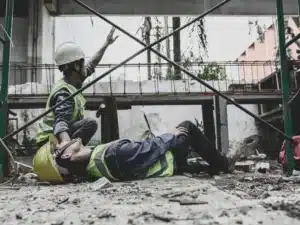


Falls remain the leading cause of death in construction, and nearly all of them are preventable with equipment that already exists on most job sites. Chicago’s skyline means a steady volume of high-rise work, facade repair, roofing, and steel erection, and every one of those trades puts workers above a lower level for most of the shift. The hazard is not exotic. It is a missing guardrail, an anchor point nobody verified, or a harness that was never adjusted to fit. Crews that treat height work as routine are the ones that get hurt.
The following are the fall protection practices that keep workers on their feet, and the rules that govern them.
Know the Height That Triggers Fall Protection
The trigger height is not the same across every workplace, which is where a lot of confusion starts. In construction, employers must protect workers on a walking or working surface with an unprotected side or edge six feet or more above a lower level. General industry sets the threshold at four feet. Shipyards use five.
Height is not the only trigger. Anyone working above dangerous equipment needs protection regardless of the distance involved, and holes in a walking surface require a cover, a guardrail, or a personal fall arrest system no matter how shallow the drop below. A floor opening waiting on a duct install is a fall hazard on day one, not on the day someone finally notices it.
Understand the Three Conventional Systems
Employers generally satisfy their obligation with one of three approaches. Guardrail systems block the fall before it starts and are the preferred option because they require nothing from the worker beyond staying inside them. Safety nets sit below the work surface and catch a worker who has already fallen. Personal fall arrest systems combine a full-body harness, a connector, and an anchorage to stop a fall in progress.
Each system fails in a different way. Guardrails fail when a section is removed for a material delivery and never reinstalled. Nets fail when the drop distance is too great or debris has been allowed to collect in them. Arrest systems fail when the anchor was chosen by guesswork rather than by an engineer or a competent person. Choosing a system is the beginning of the job, not the end of it.
Click to contact our personal injury lawyers today
Scaffolds Follow a Separate Standard
Scaffold work is governed by its own subpart of the construction rules rather than the general fall protection standard, and the requirements differ in ways that matter. Scaffold platforms generally require fall protection at ten feet rather than six. Guardrails, planking, and access all carry their own specifications.
A competent person has to inspect the scaffold before each work shift and again after anything that could affect its structural integrity. In Chicago that includes weather. A scaffold that was sound on Friday may not be sound after a weekend of freeze and thaw, high wind off the lake, or an ice load nobody accounted for. Erecting and dismantling are the highest-risk phases, and those are exactly the phases where crews are most likely to be working without complete guardrails in place.
For a Free Legal Consultation

Inspect Gear Before Every Shift
Harnesses, lanyards, and lifelines are consumable equipment. They wear out, and they do it quietly. Webbing degrades from ultraviolet exposure, chemical contact, and abrasion against structural steel. Stitching pulls. D-rings distort. Snap hooks develop gate problems that will not show up until the moment they are loaded.
Any component that has arrested a fall must be removed from service immediately, not inspected and returned to the gang box. The energy that stopped the fall was absorbed by the equipment, and it will not perform the same way twice. Workers should be checking their own gear at the start of every shift and should be able to pull a damaged harness out of rotation without arguing about it with a supervisor.
Training Is a Requirement, Not a Courtesy
Employers must train every worker exposed to fall hazards, and the training has to be specific rather than general. Workers need to be able to recognize the hazards on their particular site, understand the systems in use, know the correct procedures for erecting and inspecting those systems, and understand the limits of what their equipment can do.
Retraining is required when conditions change, when new equipment is introduced, or when a worker’s behavior shows they did not retain the original instruction. A signed attendance sheet from an orientation two years ago does not satisfy the standard on a site that has since changed methods or equipment.
Plan the Rescue Before the Fall
A personal fall arrest system stops the fall, but it leaves the worker suspended, and suspension is its own emergency. Blood pools in the legs when a worker hangs motionless in a harness, and the consequences can become serious in a much shorter window than most crews expect. Prompt rescue is part of the employer’s obligation, not an afterthought.
That means knowing before work starts who performs the rescue, what equipment they use, and how long it will realistically take. Waiting on the fire department is not a rescue plan. Suspension trauma relief straps cost very little and buy meaningful time, and a worker trained to use them can relieve pressure while help is on the way.
What to Do After a Fall on a Chicago Job Site
Get medical attention first, even when the fall seemed minor. Head injuries and internal bleeding do not always announce themselves at the scene, and the medical record created that day becomes the anchor for everything that follows. Report the incident to the employer in writing and keep a copy.
Most injured workers in Illinois are covered by the no-fault benefits system administered by the Illinois Workers’ Compensation Commission, which pays medical care and wage benefits without any showing of employer fault. That system is not always the whole picture. Construction sites bring together general contractors, subcontractors, property owners, and equipment manufacturers, and a party other than the employer may carry separate liability for the conditions that caused the fall. Those claims exist alongside workers’ compensation rather than replacing it.
Sorting out which parties were responsible for a particular site condition takes documentation that gets harder to gather as time passes. If you were injured in a fall at work, a construction accident lawyer can identify who controlled the hazard and what claims are available. Our team handles workplace accident cases throughout Chicago and can review what happened on your site.
Call 312-971-5959 or Complete a Free Case Evaluation Form