

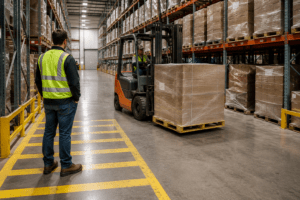
Forklifts do not feel dangerous after the first few weeks of operating one, and that is precisely the problem. A loaded lift truck can weigh several times what a car weighs, carries its load ahead of the front wheels, and steers from the rear, which makes it behave nothing like the vehicles operators drive to work. Chicago’s warehouse and distribution corridors run these machines around the clock, often in aisles shared with workers on foot. The incidents that follow are rarely mysterious. They repeat the same handful of patterns.
The following are the warehouse hazards that produce the most serious forklift injuries, and what the rules require employers to do about them.
Tip-Overs and the Instinct That Kills
Lateral and forward tip-overs cause more forklift deaths than any other type of incident, and most of those deaths happen the same way. The truck begins to go over, the operator sees the ground coming, and jumps. The overhead guard then lands on them. Operators who stay in the seat, brace their feet, grip the wheel, and lean away from the direction of the fall usually survive, because the guard is engineered to create a survivable space.
Tip-overs are set up long before they happen. Turning at speed, traveling with the load raised, exceeding the rated capacity, and driving across a slope all shift the truck’s center of gravity outside its stability triangle. So does an attachment nobody accounted for, since adding a clamp or a fork extension changes the rated capacity and cannot be done without the manufacturer’s approval.
Pedestrians and Blind Corners
Workers on foot and lift trucks sharing the same floor is the second reliable source of serious injury. A loaded forklift traveling forward with a tall pallet has effectively no forward visibility, which is why operators are supposed to travel in reverse when the load blocks the view, and to use a spotter when neither direction is clear.
Facility layout does more than operator skill here. Marked pedestrian walkways, physical barriers at the aisle ends, convex mirrors at blind corners, and dedicated doorways separate from truck routes all reduce the number of moments where a person and a machine can occupy the same space. Horns at intersections only work if they are used every time, and warehouse noise means workers on foot should never rely on hearing a truck coming.
Click to contact our personal injury lawyers today
Loading Docks and Trailer Movement
The dock is where several hazards stack up at once. A forklift entering a trailer transfers substantial weight, and a trailer that is not secured can creep away from the dock or have its landing gear collapse, dropping the truck and operator into the gap.
Trailers must be restrained by a vehicle restraint system or by wheel chocks before a lift truck enters, and trailers without a tractor attached need fixed jacks to support the front end. Dock plates and bridge plates have to be secured and rated for the load crossing them. Communication with the driver matters too, since a trailer pulling away while a forklift is inside remains one of the more predictable ways this goes badly.
For a Free Legal Consultation

Training Is Not a One-Time Certificate
Under OSHA’s powered industrial truck requirements, employers must ensure every operator is trained and evaluated before operating a truck independently. Training has three parts that all have to happen: formal instruction, practical hands-on training, and an evaluation of the operator’s actual performance in the workplace.
Training is also equipment-specific and site-specific. An operator certified on a sit-down counterbalance truck is not automatically qualified on a reach truck or an order picker, because the controls, visibility, stability, and fall exposure are different. Refresher training is required after an accident or near miss, after observed unsafe operation, when the operator is assigned different equipment, when workplace conditions change, and on a recurring basis regardless. Training citations are among the most common findings under this standard, and a certificate from four years ago on a different machine does not satisfy it.
Daily Inspection Before the Shift
Powered industrial trucks must be examined before being placed in service, and trucks running around the clock have to be examined after each shift. Anything found in unsafe condition takes the truck out of service until it is repaired.
The checks are quick and routinely skipped under production pressure. Brakes, steering, horn, lights, backup alarm, tires, forks for cracks or bending, mast chains, hydraulic leaks, and the seatbelt and overhead guard all get looked at. Operators need to be able to red-tag a truck without a supervisor talking them out of it, and a facility where reporting a defect gets someone yelled at will not have working brakes for long.
Raising Workers on Forks
Lifting a worker on a pallet, on the forks themselves, or on an improvised platform is a persistent shortcut with predictable consequences. Elevating personnel requires a platform built for it, secured to the mast or forks, fitted with guarding, and used with the truck’s controls attended by the operator at all times.
These incidents tend to occur during maintenance, inventory counts, and light replacement rather than during normal production, which is exactly when the usual procedures feel like they do not apply. They do.
After a Warehouse Forklift Injury
Get medical evaluation the day it happens. Crush injuries and impacts can produce internal damage that is not obvious at the scene, and the initial medical record establishes the connection between the incident and the injury. Report it to the employer in writing and keep a copy for yourself.
Illinois workers’ compensation pays medical care and wage benefits without regard to fault, and the Illinois Workers’ Compensation Commission administers that system. Those benefits are the starting point, not necessarily the whole recovery. Warehouses frequently involve staffing agencies, tenant employers, building owners, third-party logistics operators, and equipment lessors, and a party other than your direct employer may have controlled the conditions that caused the incident. Where a truck’s brakes, seatbelt, or guarding failed, the manufacturer or the maintenance contractor may face a separate product liability claim.
Maintenance logs, inspection sheets, training records, and video from the facility all tend to be overwritten or discarded on a schedule. If you were hurt operating or working near a lift truck, our workplace accident team can move to preserve that material and identify every party that may be responsible.
Call 312-971-5959 or Complete a Free Case Evaluation Form